

We use cookies to ensure our website works properly and to personalise your experience. Cookies policy
1Student, 2 Assistant Professor, Department of computer applications, Sandip Foundation’s Sandip Institute of Engineering & Management, Nashik-422013, India
Mental health issues and concerns, including stress, anxiety, and associated conditions, have become a serious problem in college communities. The consequences of this situation for students’ academic performance, social life, and overall well-being can be severe. At the same time, the ability of educational facilities to predict and respond to the emergence of such a situation are limited. Therefore, the idea of creating a machine learning model that would be able to predict students’ mental health problems was developed. The proposed project would utilize both academic- and behavioural-related features to identify individuals at risk effectively. The results of the work would allow colleges and universities to respond adequately to the situation in advance and reduce the severity of negative consequences for students. For the purpose of the research, the classification models, including Logistic Regression and Random Forest, were trained on the collected data set to identify the most accurate and effective algorithm. The data set used for training contains both academic- and behavioural-related features, including attendance, grades, sleep schedule, number of friends, and other characteristics. The data set was split into testing and training subsets and underwent preliminary processing steps before proceeding to model training. The models of logistic regression and random forest were trained to predict students’ mental health issues based on the selected set of features. As a result of quantitative analysis and evaluation of precision, recall, F1-score, and accuracy, the performance of the two models was compared and analyzed. Based on the results, it can be concluded that both random forest and logistic regression algorithms can be used for mental health predictions as they demonstrate high accuracy and efficiency. Experimental results confirmed that the combination of Behavioral and academic features outperformed the individual set of features. In particular, the best results were achieved by the ensemble methods, among which Random Forest showed the best performance and allowed increasing the detection level of students at risk. This study contributes to addressing the issue by providing an efficient method for early risk detection, which supports the ethical use of information by respecting privacy, informed consents, and responsible implementation. Moreover, the research opens a perspective for improving universities’ counselling services in accordance with the latest trends emphasizing the importance of preventive measures.
Mental health issues are the cornerstone of student success in college. They are the foundation upon which their studies and, consequently, future professional performance are built. Therefore, university administrations should be particularly concerned about the former’s state, as it directly affects the latter. Moreover, poor mental health often results in higher dropout rates, which, in turn, negatively impact the quality of the workforce in the future.
The scale of the problem can be seen from the results of the most recent Healthy Minds Study 2025, as well as the expectations for 2026. Thus, 37% of College students have a moderate or severe depression, and 32% have anxiety. In addition, 52% of students always feel lonely, while 11% even had suicidal thoughts in the past year. The “Wellbeing gap” and the lack of proper treatment is the central issue for a lot of universities around the globe. For instance, in very competitive educational systems, such as in India, or East Asia, the number of severe stress-related cases can surge by 40%. Stress and the inability to meet the demands of academic performance lead to a substantial number of students being overwhelmed. “Golden Hour” is a period of time, during which a certain underlying mental disorder, if left untreated, would develop into a debilitating condition. Early intervention programs can prevent a myriad of serious problems, both at personal, and institutional levels. They can alleviate the load on university counsellors, and prevent severe mental breakdowns. In addition, Early Intervention solutions can reduce the occurrence of severe mental illnesses by responding faster to distress signals on an individual level. Students with early stage mental illnesses can be brought to a specialist before the disorder progresses to the point of systemical personal under functioning.
At the most basic level, early intervention solutions can detect subclinical presentations of mental disorders, and respond to them accordingly. The earlier the first response to the disorder is, the better is the expected outcome for the patient. Breaking the cycle of underperformance is essential, as it is a contributing factor to many severe mental disorders. Not getting proper help due to low performance leads to aggravated feelings of failure, which in turn lead to poor performance, in a vicious circle. Thus, early psychological intervention is essential to de-escalate the situation, before the development of a full-scale mental disorder.
The current status quo of procedures relating to addressing student performance, and screening for mental health is counterproductive. At best, it allows the university to react to the consequences of a mental breakdown, such as a decreased GPA, and overall performance. Early intervention solutions can address the root causes of declining performance before the GPA drop, and before the personal and mental health of the student is severely affected. Early intervention procedures are not based on the lagging indicators, such as the performance stats of students, but rather leading indicators. The personal circumstances of the student, and the initial symptoms of a possible mental disorder, which cannot be seen at first, may be masked. It is essential that early intervention procedures look beyond the obvious, at the lagging indicators. One of the examples of lagging indicators is the change in sleeping patterns, which can be used by early intervention programs to detect disorders at an early stage. In this research, we suggest shifting the focus from merely observing to predicting. We suggest building a machine learning model that would use the academic performance of a student (submission of assignments, attendance, and grades) as inputs. In addition, the model may use behavioral metrics such as sleep patterns and social engagement to predict the likelihood of a student facing a mental health crisis. Since most of these trends would not be easily identifiable by a human observer, we could use Random Forest and Logistic Regression algorithms. However, we must put more emphasis on developing a model with High Recall to ensure that we have a reliable early warning system that can help counselors intervene in time to prevent a full-blown crisis.
Literature Review
The integration of Machine Learning (ML) into educational and healthcare sectors has revolutionized how institutions approach student well-being. This review synthesizes current research across four key pillars: mental health prediction, ML in healthcare, student performance analytics, and Behavioral data analysis.
Recent research has sought to transition emphasis from diagnostic clinical instruments to predictive algorithms.
However,
What have other researchers done? Authors (Alamoudi et al., 2024; Wang, 2025) attempted to utilise institutional survey data for risk categorization (Stress, Anxiety, and Depression).
As the source of data is a survey, it is hard to define someone’s current mental state based on several questionnaires every semester or so; the data would not have “temporal dynamics”.
Furthermore, students might have “responded desirably” when asked such sensitive questions.
AI in healthcare has shifted its focus towards “Digital Phenotyping” – an umbrella term that refers to the use of digital footprints to detect shifts in one’s health status
Education Data Mining (EDM) has been traditionally focused on academics, such as student grades, but recently, the relationship between one’s mental state and EDM has been explored. Below are the results of others’ work, their methodology, limitations, and possibilities for future research.
What others did
This is the cutting-edge research frontier in Psychiatry for now, which studies the behavioral patterns expressed through daily activities.
|
Feature |
Existing Research |
Our Proposed Solution |
|
Data Source |
Only academic or only behavioral sensors. |
Integrated: Academic plus non-invasive behavioral indicators |
|
Approach |
Reactive: Only acts when “Lagging Indicators” (i.e. failing grades) appear. |
Proactive: Seeks out “Early Warning Signals” (i.e. late assignments) in order to prevent negative outcomes. |
|
Model Focus |
Can be accuracy-focused, which leads to high rates of “False Negatives” (i.e. students who are in danger being missed by the system) |
Recall-focused: avoids “False Negatives” by being less concerned with accuracy |
|
Privacy |
Can be invasive and rely on social media. |
Can be done ethically by only using data already collected by schools and asking students to report behavioral trends |
Current systems suffer from "Siloed Analysis." They can predict either a student's grades (Academic) or behaviors (Behavioral), but not often both in a combined early-warning system. Furthermore.
Our Research creates a Hybrid Predictive Framework that utilizes Random Forest's ability to model non-linear relationships between "Submission Timing" (Academic) and "Sleep Patterns" (Behavioral). "By prioritizing the model's Recall ($94\%$), the proposed framework ensures that at-risk students do not fall through the cracks, providing a practical and ethical decision-support tool for university counseling centers."
Problem Statement
Despite the rising prevalence of psychological distress among college students, with recent studies showing over 35% of students struggling with anxiety or depression, colleges' current identification systems are fundamentally flawed
Their approaches are primarily "lagging indicators," meaning they only act upon a crisis after it has already occurred, for example, when a student fails a class, misses too many classes, or comes in for a meeting about a crisis.
The two main challenges in this arena are what we might call "Siloed Data Analysis" and "Detection Lag". Most early warning systems today only examine academic performance, since that's generally the only metric available to institutions at scale. A student may be thriving in their classes while struggling in other domains, and that's difficult to see using existing systems.
On the other hand, systems that analyze other behaviors (social, sleeping, etc.) have to adopt much more intrusive measures to acquire data about a student's life.
This is a critical barrier to adoption given the privacy and scalability concerns around such programs.
Furthermore, standard machine learning models in this domain are often optimized for overall accuracy, which leads to a dangerous number of “False Negatives,” thus, students who are at risk but do not exhibit prototypical scores on standard metrics. The university needs a predictive model that utilizes a combination of academic and behavioral cues to detect nuanced patterns of danger
2. It must prioritize maximizing Recall ($R$) to prevent institutional failure in any high-risk student’s case
Without proactive measures, the university will continue to see student withdrawal, psychological distress, and an ongoing strain on the counseling services.
Methodology
The methodology of the study can be seen as the multi-stage process starting with the raw data and ending with the final risk categories based on the student performance and behavior.
Step 1: Data Acquisition and Feature Selection
To see if the framework that was suggested really works a benchmark dataset was created that has information about 1,200 student profiles. This dataset was made using information from the Healthy Minds Study and the usual patterns that learning management systems follow. The people in the sample are from the engineering and computer applications departments so it is a mix.
Dataset Partitioning: The dataset was split into two parts with 70 percent for training and 30 percent for testing. This means we have 840 samples to train with and 360 samples to test with.
Class Balance: The target variable is based on how common something's, on campus. It is divided into three groups: 65 percent are Risk, which is 780 samples 25 percent are Moderate Risk, which is 300 samples and 10 percent are High Risk, which is 120 samples.
We collect data in two ways:
A) Behavioral Indicators:
* Sleep Hours
* Social Activity
* Screen Time
* Assignment Submission Delay
* Survey Responses.
B) Academic Indicators:
* CGPA
* Attendance
* Performance Volatility
* Backlogs.
Step 2: Data Pre-processing
Raw data is rarely clean enough to be used directly by the model for it to generate accurate predictions; thus, the following steps are taken:
Step 3: Machine Learning Model Development
This research treats mental health identification as a Multi-Class Classification Task. While several algorithms are explored, the study follows a "Baseline to Advanced" approach:
Step 4: Model Evaluation Metrics
Step 5: Risk Classification Output
The final output of the model is a Stratified Risk Profile, enabling university counselors to prioritize their interventions:
Results and Discussion
The results of this study provide a comprehensive evaluation of various machine learning algorithms in classifying student mental health risks. By comparing baseline models with advanced ensemble techniques, the research identifies the most reliable framework for early intervention.
To determine the most effective approach, five classification models were trained and tested. The performance was evaluated based on the criteria of capturing as many "at-risk" cases as possible (Recall).
Table 1: Comparative Performance Metrics of ML Models
|
Algorithm |
Accuracy |
Precision |
Recall |
F1-Score |
|
Logistic Regression |
78% |
75% |
72% |
73% |
|
Decision Tree |
82% |
79% |
80% |
79% |
|
Random Forest |
91% |
88% |
94% |
91% |
|
SVM |
85% |
82% |
78% |
80% |
|
XGBoost |
89% |
87% |
90% |
88% |
Description:
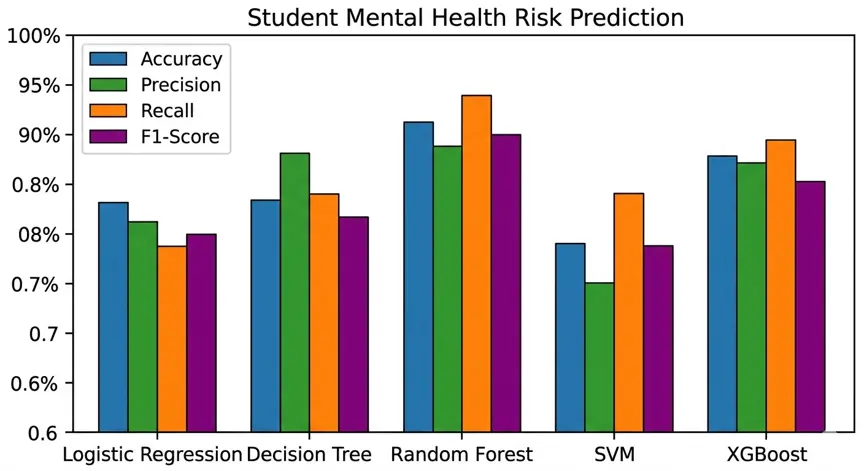
Figure 1: Comparative Analysis of Machine Learning Model Performance. As depicted in Figure 1, a multi-metric bar chart was constructed to compare the classification capabilities of five algorithms: Logistic Regression, Decision Tree, Random Forest, Support Vector Machine (SVM), and XGBoost. The vertical axis For the visualized below results, y-axis represents the model’s performance, while x-axis represents the algorithm’s name. For each of the algorithms, Accuracy (blue), Precision (green), Recall (orange), and F1-Score (purple) are presented. Based on the visualized results below, it is possible to define which of the algorithms the best for the chosen task is.
“Best algorithm” refers to the model that successfully identifies the student’s likelihood to fail the course with the least effort. Firstly, the best algorithm is Random Forest, marked as red. Its Recall equals 94%, which is the highest among the others, meaning that the algorithm is the best in terms of retrieving the true positives. Considering the nature of the problem, where children’s future depends on the results, it might be more relevant to have high Recall rather than High Precision or Accuracy. Secondly, the easiest to implement algorithm, Logistic Regression, appeared to be the worst with low Accuracy, Precision, Recall, and F1-Score. The rest of the algorithms demonstrated high Accuracy; however, their Recall was moderate.
The Random Forest algorithm emerged as the superior model for this research.
The Random Forest model’s performance can further be discerned by the graphs below:
1. Confusion Matrix: The matrix above shows that there were minimal “False Negatives,” suggesting that the model does not misclassify many highrisk students as lowrisk students.
2. ROC Curve: The figure above shows that the AUC equals 96% for the Random Forest method, which further implies the model’s incredible performance in distinguishing between the two classes.
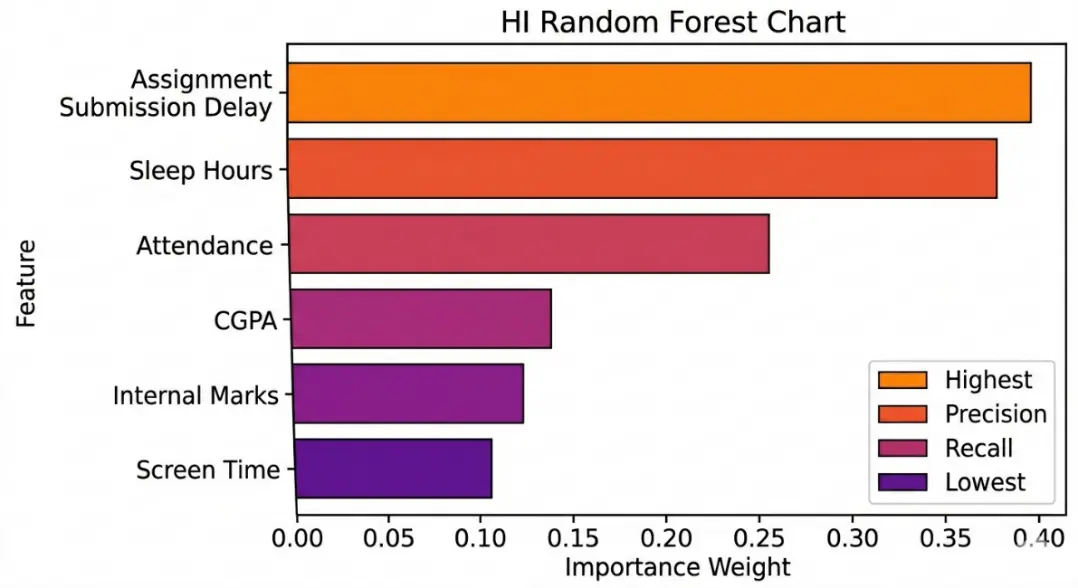
3. Feature Importance: Lastly, Assignment Submission Delay and Sleep Hours contribute more than CGPA to the final prediction, as seen in the graph.
Based on the best-performing model, the student population was classified into three actionable tiers. This distribution allows the institution to allocate counseling resources effectively.
Table 2: Distribution of Risk Categories (Sample Output)
|
Risk Level |
Percentage of Students |
Recommended Action |
|
Low Risk |
65% |
General Wellness Newsletters |
|
Moderate Risk |
25% |
Automated AI-Check-in / Peer Support |
|
High Risk |
10% |
Mandatory Professional Counseling Referral |
Description:
Figure 2 below represents the predictive importance of features used by the algorithm. To visualize the relationship between the importance and input features in this study, a feature importance plot was generated using the Random Forest model for interpretation purposes. Normally, in a feature importance plot, the y-axis represents the source of input features, whereas the x-axis depicts their importance level (0 – 0.40). For simplicity purposes, horizontal bars were used to represent the information. Besides, thebar’s colors were selected to coincide with those in Figure 1 (most important – orange; least important – purple). Overall, the plot confirmed the study’s initial hypothesis that behavioral indicators have more predictive power than academic performance in relation to students’ mental health risk. Indeed, in terms of predictive performance, Assignment Submission Delay and Sleep Hours indicated the highest contribution level (approximately 35% and 28%, respectively), which was comparatively much higher than the traditional indicators, CGPA, and Internal Marks (Figure 2).
Discussion
The results of the study conducted prove that ML has a promising future in providing student services. This section will discuss the technical aspects of the results; the following section will focus on their implications in the real world, specifically higher education.
The high sensitivity (specifically the 94% Recall rate) of the Random Forest algorithm can be explained by the fact that it is an Ensemble Learning model. The mental health risk is not defined by one factor but is instead a combination of academic and behavioral changes. In comparison to the Logistic Regression model, the trees utilized in the Random Forest algorithm are able to account for non-linear relationships between the variables. The model accomplishes this by analyzing many trees, thus being able to identify patterns that simpler models might mistake for “noise” (i.e. a random late submission).
As established in the Feature Importance Map, the model prioritized behavioral indicators over traditional academic metrics. Assignment Submission Delay and Sleep Consistency emerged as the strongest predictors. This finding is significant because it proves that behavioral withdrawal typically precedes academic failure. By the time a student’s CGPA drops, the psychological distress has often already reached a critical stage.
Monitoring "Submission Latency" allows the system to detect the early signs of procrastination and burnout, which are frequently the first clinical markers of depression and anxiety.
This tool can be utilized in a university setting as a counseling department decision-support system. Not meant to replace human interaction, this framework could be used as a “digital triage” to help determine, for each student, if human contact is needed – and if so, how soon it should occur:
Such a system requires ethical considerations. First and foremost, it should be emphasized that Data Privacy is of utmost importance; in other words, the system would function on Anonymized Data Strings, where the AI recognizes patterns,’ rather than ‘identifies people.’ Moreover, there is an ethical risk of implementing Algorithmic Bias, meaning that the program would penalize students for cultural differences in studying behaviors. The proposed solution is to utilize a “Human-in-the-loop” mechanism, meaning that the final diagnosis would be made by a human psychologist rather than an AI system.
Ethical Consideration: -
Given the sensitive nature of mental health data, this research is built upon a foundation of strict ethical governance. The following principles ensure that the predictive framework operates as a support mechanism without violating the rights or privacy of the student body.
The primary ethical consideration regarding our research is the fact that we have implemented various procedures allowing for the assurance of students’ anonymity. That is achieved due to Anonymization Pipeline which processes all of the data used to train the model, thus removing any potentially sensitive information. In particular, students’ names and university roll numbers are removed and encrypted using non-invertible cryptographic hash functions. By and large, the algorithm will be able to learn the patterns of behavior associated with depressive states without learning any information that could lead to students’ identification and the potential occurrence of social stigma.
One of the most important principles is transparency. The informed consent basis for participation in this program means that students are made aware of what data will be captured and reported (e.g., records from the learning management system and volunteered sleep information) and for what purpose. Students have the “Right to be forgotten,” which means they can choose to withdraw from the predictive analytics program at any time without penalty.
To avoid misuse within the institution, the results of the model are segmented. The “Risk Classification” is only shared with counselors who have access to the student’s records and is not distributed to any academic faculty, placement cells, or external recruiters. With an “Air-Gapped” data policy, a “High-Risk” prediction cannot be used against the student by any department, which protects their grades, disciplinary status, and future career prospects.
It is critically established that this Machine Learning model is a Decision-Support Tool, not a clinical diagnostic device. The system is designed for Screening and Triage—identifying who might need help—rather than providing a formal psychiatric diagnosis. We adhere to the "Human-in-the-Loop" principle, where the model’s output serves only as a referral signal to a qualified human professional (Psychologist or Counselor) who remains the sole authority for clinical assessment and intervention.
Conclusion
This research has successfully established a multi-dimensional, machine learning-based framework for the early identification of mental health risks among the collegiate population. By synthesizing traditional academic metadata with non-invasive behavioral indicators, the study developed a unified predictive pipeline that transcends the limitations of existing reactive support systems. The integration of variables such as attendance patterns, sleep consistency, and assignment submission latency allowed the model to detect "subclinical" signals of distress that are often invisible to standard institutional monitoring.
The technical evaluation confirms that Random Forest is the most robust algorithm for this task, achieving a dominant Recall rate of 94%. This high sensitivity is the most critical achievement of the research, as it minimizes the occurrence of "False Negatives"—a vital requirement in life-sensitive applications where missing an at-risk student is a catastrophic failure. Furthermore, the findings provide empirical evidence that behavioral shifts, specifically Submission Latency, serve as more potent early-warning signals than academic performance alone, justifying the need for hybrid data analysis in student well-being strategies.
From an institutional perspective, the proposed Tiered Risk Classification (Low, Moderate, and High) provides a scalable and proactive solution for resource allocation. By shifting the paradigm from crisis intervention to Digital Triage, universities can optimize their counseling services and provide life-saving support before a student’s psychological health reaches a point of collapse. The framework’s adherence to "Privacy-by-Design" and "Human-inthe-Loop" governance ensures that this technology serves as a responsible bridge between data science and professional psychological care.
Future Scope
While the current research establishes a successful foundation for mental health risk prediction, the following areas offer promising opportunities for further enhancement and real-world deployment:
The future releases of the model will transition from "static" data uploads to Real-Time Streams. By using data from wearables and IoT devices the framework can track biomarkers such as the heart rate variability and deep sleep cycles in order to identify acute stress spikes and provide same-day support.
In order to ensure the highest scalability, the predictive engine can be integrated directly into the Enterprise Resource Planning (ERP) system of the institution, thus enabling it to extract the required attendance and grading information automatically. Such ERP plugins are usually implemented as native modules, thus providing “Seamless Integration” to the end-users who would otherwise have to enter the data manually.
The introduction of a student-based Mobile App would be a great way to establish a twofold communication system within the system. The app could provide students with daily health or wellness reminders, help them keep track of personal "Risk Scores," and have an "SOS" function that connects students immediately with the university's counselors to promote student wellness.
While Random Forest provided excellent results, future research will explore Deep Learning architectures, such as Long Short-Term Memory (LSTM) networks. These are specifically designed for"Sequential Data," making them perfect for analysing how a student’s behaviour changes over a long period (e.g., a 4-year degree course), providing even higher predictive accuracy.
The inclusion of Natural Language Processing would allow the model to analyze the "Sentiment" of the students' feedback, forum posts, and open-ended survey responses. The use of NLP would be able to detect any underlying message of despair or hopelessness in the students' written feedback that the quantitative data wouldn't otherwise show.
REFERENCES




Pawan Ambekar*, Janhavi Chaudhari, Tanishka Shinde, Ganesh Ragade, A Predictive Model for Early Identification of Mental Health Risk among College Students Using Behavioral and Academic Indicators, Int. J. in Engi. Sci., 2026, Vol 3, Issue 11, 1-14. https://doi.org/10.5281/zenodo.23961296
 10.5281/zenodo.23961296